Showing posts with label mysteries. Show all posts

Wednesday, October 30, 2019

The Kay's Cross Mystery finally solved for good? New eyewitness testimony, withheld for decades, tells all . . .

 Kingston United Order plus a Messianic California cult leader plus Lake Bonneville stone & coal mine rails = Kays Cross? Read on to find out the full, real story . . .

With Halloween just around the corner, it's time to think about the mystery of Kay's Cross again.

And do we have a whopper of a development today!


Late last night, relatives of Malvern Hansen wrote to share with me with a detailed account of the building of Kay's Cross:
I understand there's a lot of speculation surrounding an icon in Kaysville, the now infamous Kay's Cross.

With Halloween just around the corner, I have received permission to share the story of how it came to be, from one of the last survivors who helped to build it, my father, Malvern Hansen.

Following is his story, in his own words, that he's only shared with family prior to now. He journaled it in 2012.

It is his desire now, that whoever is interested have these details as there's been so much misinformation over the years.
Charles Elden Kingston in 1940

I hope you enjoy his recollection and that it can put a lot of questions to rest.
From Malvern Hansen's 2012 journal: 
In the summer of 1946 a man came to the people of the Co-op with a plan he wanted to present to us. He called himself Dr. Pencovic, but wanted to be referred to as Krishna Venta, which when translated to our language meant Christ returned. He was organizing a group in California and was forming this group into a form of united order. He was trying to get more people to join his group and wanted our people to join him.

The leader of the co-op was Charles Elden Kingston who wanted to be known and referred to as brother Elden and wanted to portray himself as being on an equal with all the members and our group was to be referred to as the Order. At the same time he was clearly the leader of our group.

I went to brother Elden with my concerns because I didn't believe Mr. Pencovic was Christ, and he informed me he was of the same belief. However he welcomed Pencovic in order to give all the members the chance to follow him if they chose.

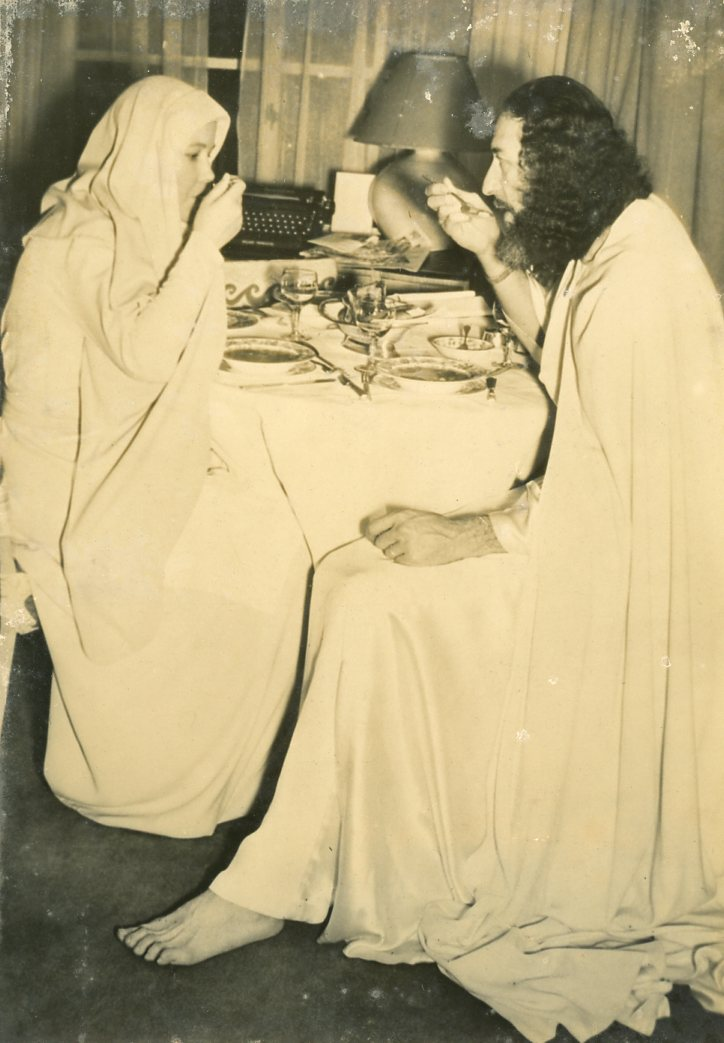
This man was about 6 feet tall, very good looking, wore a long robe, went barefoot and had a full beard.
Krishna Venta in 1946

After attending a few of our meetings he informed us that he wanted us to build a stone cross at the farm in Kaysville to pay tribute to the crucifixion and resurrection of Christ. Brother Elden agreed and organized a crew to do this. The men chosen to do this were Allen (Mac) Frandsen, Alfred Grundvig, Ammon and Ivan Nielsen, Ernie Ekstrom, Merlin Kingston, Malvern Hansen, Gerald Hansen. There may have been others, I am not sure.

A place was chosen on the hillside and we began working there. It started by us digging an excavation about a foot deep, about 10 feet long and about 6 feet wide. Then we took 3 pieces of steel rails that had been used in the coal mine to form the support for the cross. 2 of these rails were about 10 feet long and the third one about 6 feet long.

Krishna Venta in 1949
The 2 long rails were wired together at about 3 feet from the top end, then the cross rail wired to them. Then this structure was driven into the ground at the center of the excavation, then it was supported in the upright position and concrete filled the excavation holding it all in place.

Merlin, Gerald and myself had the job of gathering the rocks to make the structure. We got these rocks along the upper road where cherry hills subdivision now is. We chose rocks of suitable size and shape to do a good job.

This cross was about 9 feet tall and at the cross arm about 7 feet wide. The center of the cross about 6 feet high. At the base it was about 4 feet square and at the ends of the arms it was about 3 feet square sloping to about 2 feet where they all came together.
This view of Kay's Cross after it was destroyed
in 1992 shows the rails and other
construction details mentioned by Hansen
On the south face, right in the center was a recession about 3 inches deep and 20 inches high and 14 inches wide. Formed into this recession was the letter K which represented the word Knowledge.

After the foundation had hardened, Mac and Alfred laid up the rocks. I had the job of mixing the mortar which held the rocks together. Rather than regular mortar this was made of concrete without rocks in the mixture which made a very strong structure. Ernie created the form which formed the letter K.

The cross was never completed as we stopped work on it when Pencovic returned to California.
Krishna Venta and his wife, known as "Mother Ruth," London, 1949
 

Now a brief review about Pencovic. He was born and named Francis Herman Pencovic March 29, 1911, [and] had his name legally changed to Krishna Venta in a California court in 1951.

He openly stated he was Jesus Christ. He also claimed to have come to earth with a convoy of rocket ships from the planet Neophrates which had been destroyed for the wickedness of it's people. Soon after he left here he formed a religious cult named W.K.F.L. [Wisdom Faith Knowledge Love] at Chatsworth California.

He died in a suicide bombing carried out by 2 of his followers who blew up themselves and 8 other people after he had been intimate with the wives of these men.
This view of Kay's Cross shows the letter K and the T shapes mentioned by Mr. Hansen.  The ends of the cross arms seem to have a square shaped depression, but no recognizable letters (see first photo, above).
Other witnesses have explained that the T and square shaped depressions were intended to be filled with ornaments--work never completed (more on this later).
One of the rails mentioned by Hansen is clearly visible.
A followup conversation with Malvern Hansen in 2016 revealed a few more details:
The cross had a large letter K embedded at the center of the cross arms. There was a lot of speculation regarding what it represented, some thought it referred to Kingston, others thought it was Kingdom, but I remembered it as Knowledge.

At the end of each cross member was also engraved letters which I could not remember. This email helped me remember the other letters as W for wisdom, F for faith, and L for love, the symbol of his organization in California which he tried to organize here in Utah.
This photo of a portion of Kays Cross, 2010, shows many of the details mentioned by Hansen.
Photo credit: Rslnerd, Wikipedia, public domain

The cross was never completed, as he left before the completion and went back to California at which time we did no more work on it. Also my research found that his death by being bombed was mainly because he had been sexually involved with the wives of his killers.

I might be the only man alive who helped build the cross. If there is anyone else it would be Melvin Frandsen.

The cross was built because of Mr. Pencovic. It was part of his plan to get the Kingston group to be his followers.
The family member concludes:
My Dad is 96 years old and just wants to get the truth out there.

Does this solve the mystery of Kay's Cross?

Malvern Hansen's account is a detailed and, apparently, first-hand account of the construction of Kay's Cross.

And what a wild story it is--an isolated hollow, a secretive Mormon polygamist group and its leader, and a nascent messiah--who was later blown up by his own followers.

Is this really the story?
Think of all the stories that have been invented and passed down over the year to explain Kay's Cross: Crazed pioneer polygamists, wives buried in the cross-arms, satan worship, satanic cults, evil mysterious ghost-farmer with rock-salt in his shotgun guarding the place day and night/summer and winter, dog-men haunting the spot, murdered polygamous wives, murdered polygamous families,  William Kay and his wives, pioneers at all, polygamous family-murderers hanging themselves from the cross, six wives buried in a circle surrounding and one upright in the cross, a wife's heart buried in the cross-piece, a ghost-of-a-polygamous-wife-buried-under-the-cross-and-haunting-the-neighborhood, marauders, demons--all those and more have been passed in along in articles like this and this and this and this.

But if you grew up in Kaysville, you didn't need to read those legends on some web  page.  You probably heard them shared by your friends at school or your neighbors at church.  Or maybe told and retold during midnight hike to visit Kay's Cross.

Of course, none of us probably really believed the wilder legends, or maybe any of them. 

But Kay's Cross is such an unusual and striking artifact in such an unusual and unexpected place. 

What could explain it realistically?

What is the evidence?

Hansen's story certain makes sense on the face of it. We have already established that the Kingston group owned the Boynton farm starting in the 1940s. So the dates match.

Interestingly, although much of the speculation about the origins Kay's Cross I heard growing up in Utah involved some form of crazed or murderous polygamists, it is important to note that the Kingston group or any form of modern-day polygamist groups never figured into the picture.  Kay's Cross origins were always imagined back much further, well in the 1800s.  So murders or burials or other fantastic elements associated with the cross were always imagined to some how related to early Kaysville founders--never anything as modern as 1946.

So--just imagining Kay's Cross being built in 1946 rather than, say, 1856 or 1896 puts a whole new light on it.  And that brings up:

New evidence, new mysteries . . . 

Because Hansen's story raises as many mysteries as it solves!
  • Did Krishna Venta really meet and inspire the Kingston Clan leaders and followers in the 1940s? Is there any proof of this?
  • Are there any other available accounts of the building of Kay's Cross from this period?
  • Is there any other confirming or contradictory evidence to this version of the Kay's Cross story?
Stay tuned . . . 

Sunday, November 20, 2016

Unsolved Mysteries

As we work to solve some of the mysteries of Kay's Cross, the Holmes Creek Hollow, and Kaysville history, we will encounter more mysteries--mysteries we cannot solve yet.

I know that many of  you out there are very interested in local Kaysville history and many of you may know the answers to some or all of these mysteries--or how to find the answers.

If you know the answers to any of these mysteries, or have any clues, please leave a comment. I hope that many of these mysteries will be the subject of future posts.

Outstanding mysteries:
  • When did Elijah Laycock acquire or start farming the Boynton Road Farm? Are there any property records or other records from the 1860s or 1870s showing Laycock's ownership or use of the farm?
  • Did any Mormon settlers before Laycock live on the Boynton Road Farm, or farm there?
  • Who, if anyone, owned the Thomas and Mary Ann Green farm before the Greens moved there in 1863.
  • Did the Greens, who lived just south of the Boynton Road Farm, farm or use the Boynton Road Farm, or sell the northern property to Elijah Laycock?  Generally, who was there first--the Greens or the Laycocks?
  • Where there any Mexican Land Grants in Davis County? Miles Goodyear owned a large farm in Weber County prior to 1847. We have reports of prior ownership near Riverton in Salt Lake County.  How about Davis County?
  • More to come . . . 
Do you have information, evidence--or even just ideas or theories--about any of the unsolved mysteries above? Or a new mystery to add?

Leave a comment below or contact me via my profile page.
  •  

Solving the Kay's Cross Mystery: The Evidence Arrayed

As we work methodically to solve the mysteries of Kay's Cross, I will link to articles detailing the answers to each question--and the evidence behind it--on this page.

For now, we have only the questions--and no evidence! But, we have to start somewhere . . .


  • Who definitely did not build Kay's Cross? Who can we cross off the suspects list? Was it built by polygamists? Or satan worshippers? A religious cult? Early pioneers? Native Americans? Early trappers? Or someone else?
  • Who remains on the suspects list--who had access, opportunity, and motive at the right time?
  • Who did built it and what is the evidence they did so?
  • When did they build it?
  • Why was it built?
  • Why a cross? Mormons don't build crosses--they don't even like them. Fundamentalist Mormon polygamists--if they were involved in building it--shun the cross as a symbol even moreso then mainstream LDS.
  • And why a cross with that particular, unusual flared shape--which doesn't seem to occur anywhere else in Utah? (Or does it?)

  • Why a "K"? Was Kaysville founder William Kay involved?
  • Why the Ts and hollow squares in the ends of the arms?
  • Was someone buried nearby? Or inside the cross? 
  • Was a murder involved? Or a tragic death?
  • Why was the cross abandoned and unused for so many years?
  • Why was the cross blown up in 1992, and who did it?

The Mysteries of Kays Cross and Holmes Creek Hollow

I grew up in Kaysville--or more precisely, on the outskirts of Kaysville, in Holmes Creek Hollow, just a few hundred yards down the hollow from Kay's Cross. 

Kay's Cross
Kay's Cross
My friends and I spent all of our time playing in that hollow--tubing the creek and building secret hideouts, treehouses, and underground huts. Blazing trails and daring to crawl through dark, slimy culverts. Swimming and rafting in the irrigation ponds. Playing pirates and shark attack, Batman and dirt clod war. Building string telephones, making mudballs, skating on the ice--and falling through it more than once.

Exploring the Hollow from top to bottom, every way we knew how.

And yet, we had no idea that Kay's Cross even existed. It was a mystery so deep we didn't even know it was a mystery.

Ten or fifteen years later when some of our Kaysville friends finally let us in on the secret of Kay's Cross (thanks, guys!), a few furtive visits to Kay's Cross brought to my mind the same questions that many have asked about Kay's Cross:
  • Who built it?
  • When did they build it?
  • Why was it built?
  • Was it built by polygamists? Or satan worshippers? A religious cult? Early pioneers? Native Americans? Early trappers? Or someone else?
  • Why a cross? Mormons don't build crosses--they don't even like them. Fundamentalist Mormon polygamists--if they were involved in building it--shun the cross as a symbol even moreso then mainstream LDS.
  • And why a cross with that particular and unusual flared shape?

  • Why a "K"? Was Kaysville founder William Kay involved?
  • Why the Ts and hollow squares in the ends of the arms?
  • Was someone buried nearby? Or inside the cross? 
  • Was a murder involved? Or a tragic death?
  • Why was the cross abandoned and unused for so many years?
  • Why was the cross blown up in 1992, and who did it?
  • With so much interest and so many visitors over so many years, why is so little known about Kay's Cross? Is it really a deep, mysterious, or somehow dangerous secret?
Holmes Creek Hollow in 1953. When we moved to the hollow in 1969, the area still looked much the same. I've marked the location of our home to the left and Kay's Cross to the right. Boynton Road snakes through the center of the photo, almost connecting the two locations. The small reservoir to the lower left and the large reservoir in the center where the boundaries of my world for many years. (Click for full sized view.)
Looking back at our time that mysterious hollow, I realized these were just the beginnings of the questions I had about our little neighborhood and the people who lived nearby.
  • Who were our neighbors who owned the farm on Boynton Road where the cross is located? And what about our other neighbors? Some were new, like us, but some had lived there a l-o-n-g time.
  • Who lived in our hollow before? Who were the first Mormon settlers to come there? Were there trappers or explorers before them? Were there Native American tribes before them? And if so, what happened to them?
  • Who built the irrigation reservoirs--the upper and the lower--and why are they both dry now? What about the other reservoirs around town?  Who owns them--what are they for?
  • Boynton Road--who was "Boynton" and why was a road named after him?
  • What about other local features obviously named for someone--Green Road, Raymond Road, Flint Street, Angel Street, Shephard Lane, Nichols Road, Parrish Lane, Kay's Creek, Holmes Creek, Baer Creek, Haight Creek, Hod's Hollow, Adam's Canyon, Gailey Park, Francis Peak, Thurston Peak, Hill Field, Kaysville, Layton--and many more.  Who were these people?
  • What about those other random and slightly mysterious things one sees around town? Why does Kaysville (of all places) have a grain elevator? What about those mysterious industrial works on the mountainside? And what about those giant golf balls on the top of Francis Peak?
  • And how about those East Winds? 
Pirate Treasure Hunt in the Hollow! This was my first birthday after moving into the Hollow.
And some things are a little more mundane--things that only those of us with an interest in urban planning and development might notice. But still, there just might be a good story behind them.
  • Why does Kaysville's Main Street have such a strange zig-zag?
  • Was there really a trolley stop in front of Kaysville Elementary?
  • And what about the other unused rail lines that run through west Kaysville--when built, why abandoned? 
  • Why do the North Fork of Holmes Creek and the main fork never meet up? And why do so many of the local creeks--important enough to host mills and create hollows deep enough to deter all but the most determined road and subdivision building--seem to complete lack proper names on official government maps?
  • Even a casual look at a satellite or topographical map will show any number of mysterious lines and traces going across the countryside and even through town.  Where do they go--what are they for?
  • Where was the old Kaysville Fort? Are any traces of it left?
  • And what about old pioneer roads and trails--are they still used or can they be found?
  • What was life like in the days when Kaysville was a small farming community? What was it like before it was filled by suburban neighborhoods--and what was it like before even that, and before that?
Holmes Creek Hollow in 2015 - same two locations marked as above: Our home to the left and Kay's Cross to the right.
 And I don't want to get all maudlin or overly philosophical here--but at a time when nearly every open space in Davis County has been filled in, paved over, connected, and industrialized, the Boynton Farm, surrounded by modernity on all sides, still seems frozen in the past. That last lonely strip of Boynton Road--once you leave the newly "improved" portion behind--is still a 10-foot-wide meander along ditches and over ruts, much as it must have been 150 years ago. It's a paved road only in the very loosest sense of the word "pavement".

Boynton Road and the Boynton Farm, 2013
And those who live and work there, in the fields and the orchards, are trying their best to maintain a way of life that existed on the Mormon frontier 150 years ago--and that most of us left behind 100 years ago.  In many respects, the way they live on Boynton Road today could not be too far distant from the way Elijah and Mary Laycock, Thomas and Mary Ann Green, Rosel, Mary Ann, and Hannah Hyde, and other early Mormon settlers of the Holmes Creek Hollow area lived.

So--a little experiment investigating the neighborhood history of the Holmes Creek Hollow just might be profitable.

It might solve a few mysteries, uncover a few good stories, and tell us a little about those who came before us--and about ourselves.

And it just might settle, once and for all, the mystery of who built Kay's Cross--and why.

Mary Ann, Rosel, and Hannah Hyde. Mary Ann lived in town; Hannah--the second wife--lived on the Hyde farm toward the western end of the Holmes Creek Hollow area.

I guarantee you--murders and tragedies abound. Mysterious, gruesome, ghastly, morbid, shocking, appalling, puzzling, secretive, mindblowing, bizarre, nonsensical, dire, dreadful, disastrous, and frightening. Criminal, lawless, and villainous. And to balance things out: Heroic, daring, adventurous, brave, courageous, intrepid, and patriotic. A whole lot of steadfast and determined.

We'll find all those qualities in Kaysville history--each and every one of them in spades.

And they are all connected with Holmes Creek Hollow and the Boynton Road--somehow.

But are they connected with Kay's Cross itself?

Stay tuned--because we're going to find out.