Wednesday, October 30, 2019

The Kay's Cross Mystery finally solved for good? New eyewitness testimony, withheld for decades, tells all . . .

 Kingston United Order plus a Messianic California cult leader plus Lake Bonneville stone & coal mine rails = Kays Cross? Read on to find out the full, real story . . .

With Halloween just around the corner, it's time to think about the mystery of Kay's Cross again.

And do we have a whopper of a development today!


Late last night, relatives of Malvern Hansen wrote to share with me with a detailed account of the building of Kay's Cross:
I understand there's a lot of speculation surrounding an icon in Kaysville, the now infamous Kay's Cross.

With Halloween just around the corner, I have received permission to share the story of how it came to be, from one of the last survivors who helped to build it, my father, Malvern Hansen.

Following is his story, in his own words, that he's only shared with family prior to now. He journaled it in 2012.

It is his desire now, that whoever is interested have these details as there's been so much misinformation over the years.
Charles Elden Kingston in 1940

I hope you enjoy his recollection and that it can put a lot of questions to rest.
From Malvern Hansen's 2012 journal: 
In the summer of 1946 a man came to the people of the Co-op with a plan he wanted to present to us. He called himself Dr. Pencovic, but wanted to be referred to as Krishna Venta, which when translated to our language meant Christ returned. He was organizing a group in California and was forming this group into a form of united order. He was trying to get more people to join his group and wanted our people to join him.

The leader of the co-op was Charles Elden Kingston who wanted to be known and referred to as brother Elden and wanted to portray himself as being on an equal with all the members and our group was to be referred to as the Order. At the same time he was clearly the leader of our group.

I went to brother Elden with my concerns because I didn't believe Mr. Pencovic was Christ, and he informed me he was of the same belief. However he welcomed Pencovic in order to give all the members the chance to follow him if they chose.

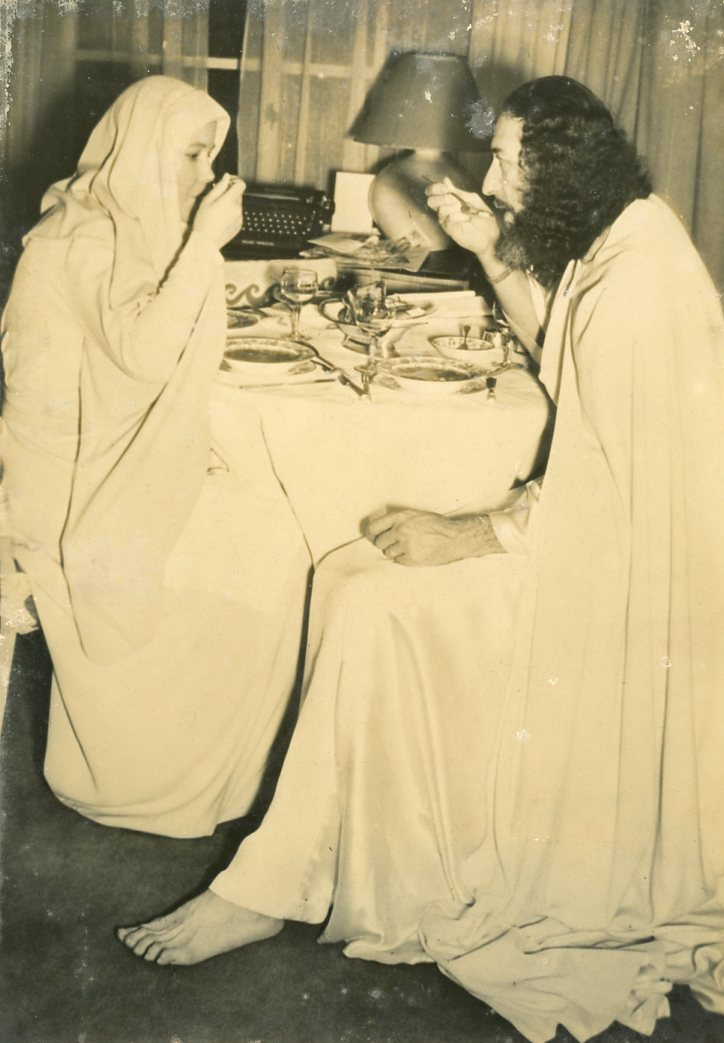
This man was about 6 feet tall, very good looking, wore a long robe, went barefoot and had a full beard.
Krishna Venta in 1946

After attending a few of our meetings he informed us that he wanted us to build a stone cross at the farm in Kaysville to pay tribute to the crucifixion and resurrection of Christ. Brother Elden agreed and organized a crew to do this. The men chosen to do this were Allen (Mac) Frandsen, Alfred Grundvig, Ammon and Ivan Nielsen, Ernie Ekstrom, Merlin Kingston, Malvern Hansen, Gerald Hansen. There may have been others, I am not sure.

A place was chosen on the hillside and we began working there. It started by us digging an excavation about a foot deep, about 10 feet long and about 6 feet wide. Then we took 3 pieces of steel rails that had been used in the coal mine to form the support for the cross. 2 of these rails were about 10 feet long and the third one about 6 feet long.

Krishna Venta in 1949
The 2 long rails were wired together at about 3 feet from the top end, then the cross rail wired to them. Then this structure was driven into the ground at the center of the excavation, then it was supported in the upright position and concrete filled the excavation holding it all in place.

Merlin, Gerald and myself had the job of gathering the rocks to make the structure. We got these rocks along the upper road where cherry hills subdivision now is. We chose rocks of suitable size and shape to do a good job.

This cross was about 9 feet tall and at the cross arm about 7 feet wide. The center of the cross about 6 feet high. At the base it was about 4 feet square and at the ends of the arms it was about 3 feet square sloping to about 2 feet where they all came together.
This view of Kay's Cross after it was destroyed
in 1992 shows the rails and other
construction details mentioned by Hansen
On the south face, right in the center was a recession about 3 inches deep and 20 inches high and 14 inches wide. Formed into this recession was the letter K which represented the word Knowledge.

After the foundation had hardened, Mac and Alfred laid up the rocks. I had the job of mixing the mortar which held the rocks together. Rather than regular mortar this was made of concrete without rocks in the mixture which made a very strong structure. Ernie created the form which formed the letter K.

The cross was never completed as we stopped work on it when Pencovic returned to California.
Krishna Venta and his wife, known as "Mother Ruth," London, 1949
 

Now a brief review about Pencovic. He was born and named Francis Herman Pencovic March 29, 1911, [and] had his name legally changed to Krishna Venta in a California court in 1951.

He openly stated he was Jesus Christ. He also claimed to have come to earth with a convoy of rocket ships from the planet Neophrates which had been destroyed for the wickedness of it's people. Soon after he left here he formed a religious cult named W.K.F.L. [Wisdom Faith Knowledge Love] at Chatsworth California.

He died in a suicide bombing carried out by 2 of his followers who blew up themselves and 8 other people after he had been intimate with the wives of these men.
This view of Kay's Cross shows the letter K and the T shapes mentioned by Mr. Hansen.  The ends of the cross arms seem to have a square shaped depression, but no recognizable letters (see first photo, above).
Other witnesses have explained that the T and square shaped depressions were intended to be filled with ornaments--work never completed (more on this later).
One of the rails mentioned by Hansen is clearly visible.
A followup conversation with Malvern Hansen in 2016 revealed a few more details:
The cross had a large letter K embedded at the center of the cross arms. There was a lot of speculation regarding what it represented, some thought it referred to Kingston, others thought it was Kingdom, but I remembered it as Knowledge.

At the end of each cross member was also engraved letters which I could not remember. This email helped me remember the other letters as W for wisdom, F for faith, and L for love, the symbol of his organization in California which he tried to organize here in Utah.
This photo of a portion of Kays Cross, 2010, shows many of the details mentioned by Hansen.
Photo credit: Rslnerd, Wikipedia, public domain

The cross was never completed, as he left before the completion and went back to California at which time we did no more work on it. Also my research found that his death by being bombed was mainly because he had been sexually involved with the wives of his killers.

I might be the only man alive who helped build the cross. If there is anyone else it would be Melvin Frandsen.

The cross was built because of Mr. Pencovic. It was part of his plan to get the Kingston group to be his followers.
The family member concludes:
My Dad is 96 years old and just wants to get the truth out there.

Does this solve the mystery of Kay's Cross?

Malvern Hansen's account is a detailed and, apparently, first-hand account of the construction of Kay's Cross.

And what a wild story it is--an isolated hollow, a secretive Mormon polygamist group and its leader, and a nascent messiah--who was later blown up by his own followers.

Is this really the story?
Think of all the stories that have been invented and passed down over the year to explain Kay's Cross: Crazed pioneer polygamists, wives buried in the cross-arms, satan worship, satanic cults, evil mysterious ghost-farmer with rock-salt in his shotgun guarding the place day and night/summer and winter, dog-men haunting the spot, murdered polygamous wives, murdered polygamous families,  William Kay and his wives, pioneers at all, polygamous family-murderers hanging themselves from the cross, six wives buried in a circle surrounding and one upright in the cross, a wife's heart buried in the cross-piece, a ghost-of-a-polygamous-wife-buried-under-the-cross-and-haunting-the-neighborhood, marauders, demons--all those and more have been passed in along in articles like this and this and this and this.

But if you grew up in Kaysville, you didn't need to read those legends on some web  page.  You probably heard them shared by your friends at school or your neighbors at church.  Or maybe told and retold during midnight hike to visit Kay's Cross.

Of course, none of us probably really believed the wilder legends, or maybe any of them. 

But Kay's Cross is such an unusual and striking artifact in such an unusual and unexpected place. 

What could explain it realistically?

What is the evidence?

Hansen's story certain makes sense on the face of it. We have already established that the Kingston group owned the Boynton farm starting in the 1940s. So the dates match.

Interestingly, although much of the speculation about the origins Kay's Cross I heard growing up in Utah involved some form of crazed or murderous polygamists, it is important to note that the Kingston group or any form of modern-day polygamist groups never figured into the picture.  Kay's Cross origins were always imagined back much further, well in the 1800s.  So murders or burials or other fantastic elements associated with the cross were always imagined to some how related to early Kaysville founders--never anything as modern as 1946.

So--just imagining Kay's Cross being built in 1946 rather than, say, 1856 or 1896 puts a whole new light on it.  And that brings up:

New evidence, new mysteries . . . 

Because Hansen's story raises as many mysteries as it solves!
  • Did Krishna Venta really meet and inspire the Kingston Clan leaders and followers in the 1940s? Is there any proof of this?
  • Are there any other available accounts of the building of Kay's Cross from this period?
  • Is there any other confirming or contradictory evidence to this version of the Kay's Cross story?
Stay tuned . . . 

Saturday, August 17, 2019

Olive Oatman: Mormon pioneer girl who lived with Native Americans for five years


We interrupt our current mystery--which itself is interrupting our main mystery, discovering the builders of the infamous Kay's Cross--to bring you a fascinating story of a Mormon pioneer girl who spent years living with Native American people in Arizona.
Olive Oatman, 1838–1903, by Benjamin F. Powelson (1823–1885), Albumen silver print, c. 1863, National Portrait Gallery, Smithsonian Institution, Washington, D.C.
The Oatman Family, including young daughters Olive and Mary Ann, joined the Mormons movement early on. In 1850, after the death of Joseph Smith, the family followed the Brewsterites--one of the several Mormon splinter movements of the time--to California.

En route the party split up and the Oatman family ended up traveling alone through Arizona, where they encountered and were attacked by a local Native American tribe, most likely the Yavapai.

Most of the family was killed, but two young girls were taken by the Yavapais. A brother, Lorenzo, was left for dead but recovered and made his way back to Yuma.

The year with the Yavapai was not very pleasant for Olive and Mary Ann--they were treated as slaves.

But a year later the Yavapai traded the the girls to a Mohave group. Mental Floss picks up Olive and Mary Ann's story from there:
[O]nce the girls were on Mohave land . .  Mary Ann and Olive were taken in straight away by the family of a tribal leader, Espanesay, and adopted as members of the community. To prove it, both children had their chins and upper arms tattooed with blue cactus ink in thick lines, like everybody else in the tribe, to ensure that they’d be recognized as tribal members in the afterlife and—interestingly, in this case—reunited with their ancestors.

The scenery was upgraded, too; the Mohave village was located in an idyllic valley lined with cottonwoods and willows, set along the Colorado River. No longer slaves, they were not forced to work, and “did pretty much as they pleased,” according to an 1856 newspaper account. They were also given land and seeds to raise their own crops. The two sisters were also given their clan’s name, Oach, and they formed strong bonds with the wife and daughter of their adopted family, Aespaneo and Topeka, respectively. For the rest of her life, Olive spoke of the two women with great affection, saying that she and Mary Ann were raised by Espanesay and Aespaneo as their own daughters.
Page from R.B. Strattion's 1858 Captivity of the Oatman Girls
The girls seemingly considered themselves assimilated Mohaves, so much so that, in February of 1854, approximately 200 white railroad surveyors spent a week with the Mohaves as part of the Whipple Expedition, trading and socializing, and neither Olive nor Mary Ann revealed herself as an abductee or asked the men for help. (The girls, unaware that their brother Lorenzo survived the attack in 1851, may have believed they had no living relatives, which could have added another incentive for them to stick with the tribe.)
It is worth remembering, reading the contemporary account below and the Mental Floss summary, that an abduction story of this kind was ripe for lurid sensationalism and inevitably seen through the eyes of European settlers.

The "woman abducted and held captive by natives" narrative was a common one on the American frontier, in both books and newspapers. Those who wrote about Oatman at the time--and probably Oatman herself--saw her experiences through that lens.

As Olive Oatman's Wikipedia article says:
In subsequent years, the tale of Oatman came to be retold with dramatic license in the press, in her own "memoir" and speeches, novels, plays, movies, and poetry. The story resonated in the media of the time and long afterward, partly owing to the prominent blue tattooing of Oatman's face by the Mohave. Much of what actually occurred during her time with the Native Americans remains unknown.
Given that, it is one of the few extensive first-hand accounts by a European settler living with the Native American tribes in this part of the country, and worth considering, even if through a lense we know is distorted.

Below is the article about Olive Oatman in the Sacramento Daily Union, 25 April 1856:
Olive Oatman, the Apache Captive

So much interest has been manifested in the story of the captivity of Olive Oatman, that we visited her a few days since, when she gave us an intelligible account of her adventures, which is here embodied. This account we obtained only by asking questions, as her timidity and want of confidence prevented her from giving the details unassisted. Her faculties have been somewhat impaired by her way of life, but her friends assured us that in the short time she has been among them she has made very perceptible improvement.


Olive has found good friends at the Monte, in the families of Mr. Ira Thompson and Mr. David Lewis, and is regarded and treated as a member of their families.


The Oatmans started from lowa in company with the family of Mr. Thompson, with whom they traveled together as far as Tueson, in Sonora, when Mr. T. resolved to lay by to recruit his cattle and wait for other trains to come up, so as to insure the safety of the road by numbers. But the Oatmans pushed on, impatient to get through, and met their fate on the Gila, about two hundred miles from the Colorado. While at Tucson, the Thompsons had many opportunities of noticing the terror which the Apaches excited in the people. One evening a Spanish woman arrived in the village, saying she had just escaped from the Tonto Apaches, where she had been a prisoner. She related that a day or two before, the band returned to camp from killing and plundering a party of Americans, and also bringing in prisoners. She was left alone with the threat that if she attempted to escape she would be killed. That night while they were dancing the war dance, she escaped and returned to Tueson. By comparing dates they were satisfied this was the band that attacked the Oatmans. Inquiries were made at the time, but nothing could be learned concerning the captives.
Carte de Visite of Olive Oatman 1838–1903, by Benjamin F. Powelson, 58 State St, Rochester, NY (source)
Olive is rather a pretty girl, with a skin as fair as most persons who have crossed the plains. Her face is disfigured by tattooed lines on the chin, running obliquely and perpendicularly from her mouth. Here arms were also marked in a similar manner by one straight line on each. The operation consisted in puncturing the skin and rubbing a dye or pulverized charcoal into the wounds.

It was about sunset when the attack was made, which resulted in the capture of herself and her little sister, Mary Ann. Olive was thirteen, and Mary Ann seven years of age. The Indians stripped her of her shoes and nearly all her clothing — her sister had no shoes on at the time — and they started off with the speed of horses in a northerly direction, into a mountainous region. They traveled all night without resting. At noon next day they stopped a few minutes to breathe, and then hurried on again until nightfall, when they came into camp. She thinks they traveled a hundred miles. She was barefoot, and the sharp stones lacerated her feet, and her blood sprinkled the whole distance. Whenever she lagged, they would come behind and beat her, to urge her on. Her sister soon gave out, but being small, the Indians carried her in their arms. The reason of their hurrying on so rapidly was fear lest they might be pursued.

The clothes left to her were worn out, and fell from her back in two weeks, and then she matted together the bark of trees, and tied it around her person like the Indians. It was a slight covering, but it did not leave her entirely exposed.

Among these Apaches, Olive supposes they remained one year. At any rate, the same kind of season returned as that when she arrived. Time among the Indians is not noted. If they note it at all, is only by moons. The country was mountainous, and barren of grass or timber. The Indians live in the small valleys. The girls were treated cruelly by these Indians. They were overtasked, and when they could not understand what was said to them, they were beaten. There was no timber nor running stream. The only fuel to be had was scattered sage bushes, and when it rained, the water would collect in the holes of the rocks, and these two little girls were compelled to pack all the wood and water from long distances upon their backs. They felt themselves to be slaves. The Indians told them they should never see their friends again, and concealed them as much as possible. There was no snow, but they suffered from cold in the winter.

The Mohaves and Apaches were friends, and sometimes visited each other. It was during one of these visits that the Mohaves learned of the captives, and offered to purchase them. The Apaches consented, and received in exchange a few pounds of beads, two horses and two blankets. They were ten days traveling "like horses," as she describes it, to the Mohave villages, barefoot and over a rough, mountainous country, each day stopping a short time at noon to rest, she thinks they traveled 350 miles in a northwest direction.

On this journey they eat nothing until the fourth day, when they received a piece of meat about as large as her hand, and this kept them alive. There were no roots nor berries, and they dared not ask the Indians for food. The Indians would kill such game as came in their way, but they did not offer it to their captives. She describes them as being too lazy to exert themselves to procure food, and only killing such game as chance brought to them. Her days had thus far been dark, and she was almost ready to despair. Not an act of kindness nor a word of sympathy or hope had been addressed to her by her captors, who treated her and her sister as slaves.

Arrived among the Mohave, the Chief, whom she calls Espanesay, took them into his own family, and they were treated in every respect as his own children. Two blankets were given to them for covering; food was divided with them; they were not obliged to labor, and did pretty much as they pleased. Lands were allotted to them, and they were furnished with seeds and raised their own corn, melons and beans, as the Indians did.

There is little or no rain at the Colorado, and the Mohaves depend upon the overflow of the river for the irrigation necessary to germinate and ripen their harvests. Sometimes there is no overflow of the river, and much suffering follows. The Indians are too indolent to plant more than will suffice for their actual necessities. Three years ago there was no overflow, and a famine was the consequence, in which many perished. It was in this famine that Olive suffered her greatest grief. Her little sister, Mary Ann, had endured all her captivity with her. They supposed that they were alone of their family; they had suffered together the cruelties of the savages; but they had not been separated. They could sympathise and cheer each other in their dreariness, and sometimes they would whisper together a faint hope of future redemption. But now came the trial. The child wasted away by degrees; she knew that she was to die, and talked calmly of death to Olive. She had no disease; but there was no food; and she wasted miserably in the famine that desolated the tribe. Olive herself was near perishing, but the strength of her constitution saved her life.
Page from R.B. Strattion's 1858 Captivity of the Oatman Girls
She speaks of the Chief's wife in terms of the warmest gratitude. A mother could not have expressed more kind hearted sympathy than did this good woman, whose gentle treatment saved her life. This woman had laid up seed corn to plant, and which even the dying groans of her own people could not make her bring out. When she saw Olive's distress she ground this corn between stones, made a gruel, and fed it to her, not reserving any even to herself.

The Mohaves always told her she could go to the white settlements when she pleased, but they dared not go with her, fearing they might be punished for having kept a white woman so long among them; nor did they dare to let it be known that she was among them. She could not go alone, for she did not know the way, and she despaired of ever again seeing her friends. Hope almost died within her. For three long years she mourned her captivity ; though well treated, she was restrained, for she knew not how to extricate herself. What were her sensations during all this time must be imagined, for she is not as yet able to express her thoughts in language.

Before the arrival of the Indian messenger charged to release her, she heard of his departure from the Fort, by an Indian runner. Her joy was very great, but she forced herself to appear indifferent, lest the Indians should still restrain her. She had little confidence in their sincerity, when they gave her permission to leave them, because they refused to go with her, and they knew she could not go alone.

At length, Francisco, the Yuma, arrived with the requisition from Col. Burke for her delivery. The packet was examined by the Indians, but no one understood it. It was put into her hands to explain. It was written in a bold round hand, the letters being a third of an inch long. It was the first word of English she had seen for five long, weary years, and she could not restrain her emotion. The cold chill of Indian reserve seemed to melt away, and she saw before her mind the old home scenes; and happy voices seemed to welcome her return. She readily deciphered the meaning of that rescript, and communicated it to the assembled Indians. Accompanying it were six pounds of white beads, four blankets, and some other trinkets, to be given in exchange. These were accepted, and the Chief told her she was at liberty to depart for her friends. Many of the Indians, however, objected to her going, fearing they would be punished as her captors. The Chief's wife, the kind woman who saved her life in the famine, cried a day and a night as if she were losing her own child, and then gave her up. With the guide she started for the Fort with a light heart, on foot, as usual. She was ten days on the road, traveling with greater speed than ever before. This time the days were short to her, and so great was her mental excitement, that she knew neither weariness nor hunger. The trail was tortuous and rough, leading through mountains and gorges, and several times she was compelled to swim the Colorado. This time, too, her feet were protected from the sharp stones by sandals, such as are worn by the Indians.

During all her captivity she does not remember to have seen a wild flower or shrub. If there were any her mind was so absorbed with her own misery that she did not observe them. Among the Mohaves there is no food except what is raided—that is, corn, wheat, melons and beans. A few fish are caught from the river, a small bulb, resembling a bordeia, is taken from the ground, which is boiled or roasted. This bulb is almost tasteless, and is found in such small quantities that a whole day is required to gather enough for a meal. There are no berries or fruit trees of any kind.

The Yumas and Mohaves are friends. Their manners, customs and dress are the same, and their lodges are built upon the same plan. Their language, also, is similar—they easily understand each other. The two tribes last year made war upon the Cocupas, and took several prisoners. When they arrived at their villages the prisoners were killed, and the dead bodies suspended on a crucifix, while the whole tribe danced round the pole, singing and throwing arrows into the bodies.
Olive Oatman, 1857 Tintype portrait, Beinecke Rare Book and Manuscript Library (source)
She converses with propriety, but as one acting under strong constraint; and she has not forgotten the instructions of her childhood. She reads well, writes a fair hand, and sews admirably; though in her captivity she saw no implement nor instrument of civilization. She is very ambitious to learn, and spends most of her time in study.
 True West magazine takes the time to debunk 10 Myths about Olive Oatman, including:
1 – Her captors were Apaches. 
2 – The rest of the Oatman family was killed in the massacre.
3 – She was a slave to the Mohave.
4 – She wore a tattoo that marked her as a captive.
5 – Her Mohave nickname was Olivia.
6 – She wanted to leave the Mohave but had no opportunity for escape.
7 – She married a Mohave and had Mohave children.
8 – She hated the Mohave Indians.
9 – She lived happily after her ransom.
10 – She died in an insane asylum.
Note that these are all myths--at least partially incorrect for one reason or another. Read the full article to find out the details.

More information about Olive Oatman:
 

Monday, July 29, 2019

A Handcart Trek Mystery - Part 2: Mary Mathieson and the Luggage Disaster


Our exploration of the life of William Heaton and his family in Part 1 of A Handcart Trek Mystery solved a few mysteries but raised a few more. Among those:
  • Who was Mary Mathieson and why was she living and traveling with the Heatons in 1856?
This is a mystery that turns out to have a very interesting solution--but, unfortunately, a very tragic conclusion.

Mary Mathieson on the Enoch Train with the Heaton family


If you recall, in the passenger list for the ship Enoch Train (above), Mary Mathieson is listed as living with the William and Esther Heaton family at 50 Pleasance in Edinburgh immediately prior to the voyage. Heaton had been President of the Edinburgh Conference for the preceding two years and his family had lived in Edinburgh with him.

Between Mathieson and the Heatons on the passenger list is Daniel D. McArthur, who until recently had been President of the Dundee Conference, very near to Edinburgh.

And there is a strange and difficult-to-decipher note in the "Remarks" column for Mary Mathieson:


What does that note say and what is its significance?

All those questions--and many more--are answered in a real treasure trove of pioneer Utah history, the Autobiographical Sketch of the Life of Richard John Moxey Bee.

EXCERPT from the AUTOBIOGRAPHICAL SKETCH OF THE LIFE OF RICHARD JOHN MOXEY BEE

Written from memory at the age of 75, while living in Georgetown, Idaho
I started on foot for Salt Lake but did not succeed in getting a job as I kept going on only stopping overnight in the city, and reached my Sister Jane’s house at Sessions Settlement, 10 miles north of the city and was entertained by her and Mr. Hatch, her husband.
Richard John Moxey Bee
They had a good large farm and were pretty well to do.  I engaged to stay with them and help him on the farm, which I did and the following summer farmed for him on share.

Richard receives an endowment from Herriots Hospital, Edinburgh, and uses it to help a lady friend emigrate to Utah

That year 1856 I became of age, 21, and about time I was applying for an endowment that was due me from Herriots Hospital.


I accordingly made out the papers stating how I had spent the time during the intervening years since leaving the Institution.  Certified to by several employers and me and of my good character morally. Of course some of my employers were imaginary, as they were entirely out of my reach.

I wrote Apostle Franklin D. Richards, then President of the European Mission, and residing in Liverpool, England.
Franklin D. Richards, President of the European Mission in 1855
I stated to him all the circumstances of the impending case, telling him what course to take, as my attorney to secure the money due me.
He received my letter, following out my instructions, proceeded to Scotland, applied for the bonus, succeeded in getting it, and after calling on a young lady I mentioned, offered her a chance of emigrating to Zion in America.
She was overjoyed and embraced the opportunity offered.
Elder Richards dealt honorably in every respect, paid himself 10 percent of the proceeds, emigrated the sister, and reported to the Perpetual Emigrating Fund that there was still $20 owing me at the same time writing me to call at the office in Salt Lake City and receive the balance due me.  In due time I went, presented myself at the office and I was asked what I wanted done with the remainder of the money.  I was so elated over the prospect of the sister coming I replied I would donate it to the Perpetual Emigrating Fund and perhaps it might help someone else.

Mary arrives in Utah--but not as expected

To get back to my story.  During the summer of 1856 I was still living at Father Hatch’s and while there I had heard that Mary Mathieson, the sister I expected from Scotland, was on the way to Zion, and I was on the lookout, when any of the wagon trains would arrive.

It so happened that during her stay in Winter Quarters she had been persuaded by her companions in travel not to forsake them but to continue as she was and travel with them in the noted “Hand Cart” companies that were now organizing for a trip across the plains to Zion.
Daniel D. McArthur, leader of the 2nd handcart company, the company Mary traveled in
Her fare along with her luggage had been paid to travel in the wagon trains, but I, not knowing of the change, was expecting her along with the wagon trains ‘til I heard she was traveling with the 2nd Hand Cart Company in charge of Captain McArthur, which in due time arrived in Salt Lake.  I think about the latter part of September or the first of October of that year.
Esther Beilby Heaton

I met her on the campground but did not recognize her.  My sister, Mrs. Hatch, had reached her before I got around and I saw my sister pointing in my direction and supposing the girl with her was the party I was looking for advanced towards them.
Mary Jane McCleve, who traveled with the 2nd handcart company--and whose relatives also did not recognize her on arrival in the Salt Lake Valley.

After the preliminaries of introduction were over, she bid good bye to her companions, got into the wagon waiting for her, and accompanied us to my sister’s home in Sessions Settlement, now Bountiful.

Richard and Mary court and wed

We got quite intimate in our acquaintance, and my attentions more closely, ‘til it culminated in our marriage the 4th day of November following by Bishop Stoker of Bountiful.  After our marriage we moved to our home in Lehi where I remained ‘til the following fall.

Pregnancy, loss of possessions, disaster

In consequence of my wife’s having come across the plains with the hand carts she left the principal part of her clothing at Winter Quarters, then Florence, to be sent on with the wagons getting a receipt for 90 lbs. weight.

The wagons were detained at Sweet Water being belated, and had to remain there ‘til the fall of 1857 and notices were sent out to those having luggage in the train to call for it.

My wife and I accordingly made a journey to the city, expecting to get her luggage as per receipt.  All that could be found was shown to her in a small bundle tied up in a skirt, about 10 lbs. instead of a chest of clothing she had left.  She was so disappointed and horrified she fainted away to unconsciousness.  I had her conveyed to Bountiful 10 miles north of Salt Lake, where my two sisters, Mrs. Hatch and Mrs. Thompson lived.

We went directly to Mrs. Thompson and there my wife was prematurely confined of a baby girl, but who died about 10 hours afterwards.  She was born on the 10th day of October. Her mother surviving her by only three days never having recovered from the shock, caused by her disappointment.

After the internment of my wife and child I returned sorrowful and lonely to my home in Lehi.  I followed farming in company with Father Dobson, ‘til the winter of 1858-59.

Companions in travel

Clearly, the Heatons and McArthur must have been among "companions in travel"--perhaps the prime movers among those companions--who, Bee notes, urged Mathieson "not to forsake them but to continue as she was and travel with them in the noted 'Hand Cart' companies."

William Heaton, as Edinburgh Conference President, may well have been involved in Bee's business with endowment at Herriot's Hospital as well.  The Pleasance, where Heatons lived, was just a few steps away from George Heriot's School:


So what about that mysterious note?

Remember the "remark" entered on Mary's line on the Enoch Train passenger list?


This looks to read something like:
£q debited J. M. Bee
Also £o paid Mary
Matthieson See folio No. 188
There are some question marks there as to various words and numbers, but clearly it is indicating the amount paid by Richard for Mary's passage on the Enoch Train.

Not recognizing handcart travelers on arrival

"I met her on the campground but did not recognize her."

A similar incident was reported by Sarah Jane McCleve, who traveled in the McArthur company with Mary. When she and her mother arrived, they were looking for her two sisters, who had emigrated a year or two earlier:
We moved along the street watching very carefully. Finally Mother gave a shriek of joy and hurried to a group of people standing on the front porch of a store. The wooden porch was about a foot higher than the street. The group paid no particular attention to us except to cheer for everyone. I could see Mother’s dusty smile begin to fade as she stood looking at the crowd. I didn’t recognize the two well-dressed women with the big fancy hats and pretty dresses. I guessed my eyes were full of mud and exhaustion. Finally Mother reached up and took hold of Sarah’s arm. “Sarah, don’t either one of you recognize any of us?” she asked.

The disastrous luggage transport 

"All that could be found was shown to her in a small bundle tied up in a skirt, about 10 lbs. instead of a chest of clothing she had left."

Others in the handcart company complained of the problem with luggage transport. The McCleves lost most of their luggage during the railroad, when many travelers were packed into luggage cars alongside the luggage in order to save on the cost of a train ticket.

But Frances Hiley Booth Hanson reports that the situation for luggage left behind in Iowa City for later transportation to the Salt Lake valley--as was the case for Mary Mathieson's chest--was even worse:
Before starting for Florence the company had to leave there luggage which was piled up out of doors with the understanding that it would be delived at S.L.C that fall but it was not until the next and much of it was received for it was exposed to the weather all winter. 15 pounds pr. head was all that was allowed to be taken with the cam[p]. including beding clothing cooking in fact all we had for use.
It's no wonder Mary was devastated by the unexpected loss of her life's possessions in that chest. She had already culled her things down to the bare minimum before boarding the Enoch Train, and the few remaining keepsakes in that chest represented her only tangible connection to her life and family back home in Scotland.

A Handcart Trek Mystery, Part 2. Part 1 is here.

Sources 


Friday, July 26, 2019

William Heaton and A Handcart Trek Mystery - Part 1

William Heaton was my great-great grandfather. I have been doing a little research into him because of some minor mysteries about his life:
  • What was he doing between August, 1853, when his missionary journal ends, and March 1856 when he and his family boarded the ship Enoch Train for America?
  • Where was William's second son, William McDonald Heaton, born, where and when did he die, and where is he buried?
William Heaton is father of Jonathan Heaton, father of Amy Heaton, mother of Jeanette Hugh, who is my mother.

1849-1853: Baptism, missionary work, marriage

William was baptized in 1849. About a year later he was ordained elder and given his Elder's License.
 

William was active as a missionary--or "Traveling Elder," as they were called--in the Yorkshire area of England for the next three years. This was the immediate area of where he was born--Little Horton, near Bradford.

Today, Little Horton looks like this:


Yorkshire is right smack in the middle of England, near Leeds and York. It is about halfway between London and Edinburgh.William traveled often to Leeds and York, but more often to the many smaller towns and villages in the area. The missionaries considered this area the "Bradford Conference".


Along the way William preached to the Beilby family, converted some of them, and married Esther Beilby.  He kept a diary for those years that is now in the BYU archives.  You can read William's Missionary Journal online here.

William's family lived in Wilsden by this time, and that is where he was ordained an elder and began preaching:


Esther's family lived in Wheldrake, a place William visited often.  In fact, as a traveling elder, he was criticized for visiting Wheldrake too often and neglecting the other areas he was responsible for.

Wheldrake today:


What next?

What I was looking into is what happened the next couple of years.  The Heatons didn't leave for America until March, 1856.  If you read the account in Esther's Children, compiled by a grand-daughter and great-granddaughter of William and Esther, no mention is made of this period--about two and half years starting in August 1853.

When Esther's Children was compiled, the

So what were the Heatons doing from the end of 1853 to the start of 1856?

Something pretty interesting, it turns out . . .

1854-1855: Conference President in Edinburgh


So, he was appointed President of the Edinburgh Conference, starting January 1st, 1854. This was missionary work, of course, but also generally being in charge of that entire "Conference" which consisted of 724 souls. In today's terms, it was probably very similar to being Stake President.


William McDonald Heaton born in Edinburgh

The whole family moved to Edinburgh, including Esther and Christopher, who was a year and a half old in 1854. The new baby, William McDonald, arrived September 13th, 1855--his birth and parents are listed in the Statutory Register of Births for Scotland that year.

The family lived at 50 Pleasance in Edinburgh, which seems to have been a "Conference headquarters" location where various Conference leaders and Elders lived over the years.

You can take a look at that neighborhood here--it must still look much as it did in 1854:


Among their neighbors on Pleasance were the Masonic Lodge and the Society of Friends.

William continued as Conference President through 1855:


In July 1855, Edward Bunker wrote:
Edinburgh Conference came off on the 24th, when we: were favoured with the society. of Elder James Ferguson and J. D. T. McAllister, from Ireland, and Elder Walter Grainger, President of the Glasgow Conference, who contributed much to our happiness on that occasion for our heavenly Father gave us much of His good Spirit, which is life, light, and salvation to those who enjoy it. The Reports from the Branches. of this Conference were also very favourable. The Saints there feel well, and realize· more the necessity of keeping the commandments of God, than ever they did in their lives. They also have a
good man to preside over them, whose heart is devoted to the cause of truth; and the Saints love and respect him very much.
We have now in that Conference three Travelling Elders, two of them we called out at our last Conference meeting, the other has laboured some time in the miniatry, and he is a faithful, worth: man' ·and would do great good in any sphere.
The total number of members is 672. They have paid to Temple Fund this quarter, £20 17s. 11d.; to P. E. Fund, £25 9s, 9d.; to Foreign Missions, £3 10s.; to clothing for Elders, travelling expenses, and the support of families, £46 15s. 9 1/2 d.; total for the the quarter, £96 13s, 5 1/2 d.
At the end of 1855 William was released as Conference President:

1856: On to America

In March, 1856 the family boarded the ship Enoch Train for America:


The Enoch Train passenger list has a few interesting details:
  • The family's previous address, which (as noted above) was 50 Pleasance, Edinburgh.
  • William, 28, is a "woolcomber," Esther, 25, is "wife," Christopher is 3 years old and William McDonald 5 months.
  • Mary Mathieson, 21, "spinster" had been living with the Heaton family at 50 Pleasance in Edinburgh and was now traveling with them. See the notations on her listing--there is a whole other story--and mystery--there (Part 2, coming soon).
  • This was the first group to use the Perpetual Emigration Fund for their travel--see notation for each person on the passenger list
  • This was also the first group to travel across the plans via handcart
  • The Heatons became part of the second handcart company, led by Daniel McArthur.  This company left Iowa just a couple of days behind the first handcart company and arrived in Salt Lake the same day.
  • Note McArthur's name just above the Heatons - McArthur had been President of the Dundee Conference, very nearby Heatons' Edinburgh Conference.

The Handcart crossing and beyond

The handcart crossing must have been pretty hard on them all. Friends and relatives of Mary Mathieson and the McCleves, who traveled with the Heatons, made special notice of the fact that they didn't even recognize their relatives when they first arrived.

They moved first to Payson, then the Muddy Mission, then Long Valley, and then in 1874 joined the Orderville United Order, where William was named as the first Secretary of the Order.

Esther died soon thereafter, at age 45, during a trip to visit friends and relatives back in Payson.

In 1876, William had a short-lived marriage to very interesting character Susan Clarissa Williams (who crossed the plains in a boat) before he, too, died at age 50.

Neither of them got to enjoy their time in Orderville for very long!

Mysteries solved, unsolved--and raised 

So we have solved a few of our mysteries:
  • What were William Heaton and his family doing late 1853 to early 1856? They moved to Edinburgh, where William was Conference President.
  • Where was second son William McDonald born? He was born in 1855 while the family was living in Edinburgh.
But we have raised a few more mysteries:
  • Who was Mary Mathieson and why was she living and traveling with the Heatons?
  • Who is Susan Clarissa Williams and how does she fit into William's life?
And our primary mystery is still unsolved:
  • When did infant William McDonald die and where was he buried?


 Sources

Friday, May 11, 2018

Amy Heaton and the 1918 Spanish Influenza epidemic in southern Utah

Amy Heaton at 16
In this post, we're taking a little break from Kaysville history to take a look at another other interesting episode in Utah history.
The Spanish influenza epidemic of 1918-1919 hit Utah hard.
My grandmother, Amy Heaton Esplin Crofts, was 16 years old and attending her first year at Dixie High School in 1919. This is the story of Amy's encounter with the Spanish Flu, the death of Amy's sister Mercy the following year of appendicitis, and the end of formal schooling for Amy and her family members who were attending school in St. George at the time.
Amy grew up in the small town of Moccasin, Arizona on the Arizona Strip--the narrow strip of Arizona north of the Grand Canyon. She went to high school in St. George Utah--two days' journey by wagon or early automobile--when she was 16, in the year 1919.

Amy's story


After completing grammar school at Moccasin, I went to high school in St. George. I was sixteen years old. I weighed 103 pounds. My wardrobe consisted of four dresses. I remember I would gladly have turned back and not left home. I had such an empty feeling in my stomach. I was so homesick.


St George, Utah, in the 1910s (courtesy Utah State Historical Society)

All my life I have had good health and hardly ever a bad cold. While I was in St. George attending school, I had influenza and pneumonia. President Romney would come over to see me often and administered to me. Dr. McGregor didn't think I would pull through. On one especially bad one night, when the doctor checked on me, he thought I wasn't going to pull through. When he came the next morning, he said, "Well Amy, you surely must have a mission on this earth or you wouldn't have been alive when I came this morning." President Romney however, died of influenza before I was ever out of bed.

My half sisters, Elsie and Mercy, and my niece, Jennie, and I would take in washings on Saturdays to help pay for our schooling. Two winters a group of us batched. The last winter we boarded at a Mrs. Smith's. While we were living there, Mercy died of appendicitis. Papa had us all come home. That ended my schooling. I was disappointed that I couldn't finish high school. I cherished each day of school I attended. I also missed the friends I made at Dixie.

Excerpt from  "My Own Story" by Amy Heaton Esplin Crofts, 19 October 1903-17 May 1977.
Lucy Heaton Esplin, sister of Amy Heaton, also wrote her account the influenza epidemic and includes another, earlier incident involving Amy.

Lucy's Story

I, Lucy Heaton Esplin, with my children was staying with my parents Lucy and Jonathan Heaton at Moccasin the winter of 1923*, while me husband, Lawrence, was out at the sheep herd. All of the children got the red measles--Lavar, Carol, Gueneviere and Amy Heaton, Larry, Nan and Amy Esplin. Amy Heaton, my sister, was really sick with the measles and then she got Pneumonia along with them. Mother did all that she could for her but none of it helped and mother began to feel that her youngest child would surely die.

The Big House in Moccasin, where the Heatons lived
One afternoon mother prayed that Heavenly Father would show her what to do for Amy. She was exhausted and lay down for a rest. A voice spoke to her saying, "Vinegar and hops, vinegar and hops and put it on hot."

Mother was so weary she wondered if she had heard rightly. "In a little while" she thought and whispered to herself.

But the voice came again, "Do it now, before too late." Mother got right up and made a poultice of hot vinegar and hops and put it on Amy's back and chest. In a little while the congestion was relieved and her breathing was easier. She improved rapidly and was soon well. Mother always said if she had waited to heed the voice Amy would have died. She thanked her Father in Heaven for showing her what to do. Later while Amy was attending school in St. George she got Pneumonia again and was real bad. The Doctor there thought she would not pull through. She had just passed the crisis when she came down with the flu that was so bad that winter.

Mother was called from Moccasin to Amy's bedside. She cared for her night and day until she got the flu also. One afternoon while she was resting near Amy's bedside a glorious light filled the room. She saw six beautiful white hands hover over her daughter's bed. The hands lowered and lifted Amy from the bed. They just held her for sometime and then placed Amy back on the bed by her mother’s side. The light and the hands left the room. Mother knew that Amy's life had been spared. She again thanked her Father in Heaven for this blessing.
Moccasin AZ and the Big House

Dr. McGregor had left her sick bed the night before thinking that Amy could not possibly live until morning. When he found her improved he exclaimed, "This girl must surely have a mission to perform here on this earth, for as sick as she was, she would never have gotten well without some special help." The family was saddened when Brother Romney, Pres. of Dixie College at that time contracted the Influenza and died before Amy was out of bed. He had administered to her several times while she was so bad.

Lucy Heaton Esplin daughter of
Jonathan and Lucy Heaton

From Esther's Children: Her Story and a Collection of Faith Inspiring Experiences, compiled by Gwen Heaton Sherratt and Hannah Heaton Roundy, 1968, p. 157.

Note that the date 1923 appears to be a mistake and may simply be a typo for 1913.

This final account is by Charles Leonard Heaton, nephew of Amy Heaton. Though Leonard was Amy's nephew, he was two years older than she and both went to Dixie High School in St. George together.

Leonard's story

First year 1919-1920

One day the fore part of September the men folks of Moccasin had collected at Grandma's place, which they did about once a day discuss the affairs fo the day and work. Grandpa was there having come down from Alton the night before. He asked Father if he was going to send Leonard and Jennie to St. George to attend the Dixie High School. Father said Jennie was going and that I was going part of the year at least. This was the first I knew Father and Mother had ever planned on my getting any more education. I had spent parts of three winters in eighth grade and never graduated. 

Father then asked me when I wanted to go, now or later in November. I said, "Well, if I am going to get part of it, I would just as soon take it all." He said, "Get your things ready Harold will be out in a few days with a team to haul your things to St. George."

The Heaton's going to school were my Aunts Amy and Mercy and Uncle Harold from Alton, Jennie, my sister, and I. Harold and I drove a team and wagon loaded with bedding, food and our belongings. The first stop was Short Creek, next Hurricane and the third day we arrived in St. George. We stayed at Grandpa's brother's, Uncle Will Heaton. They had a house with several rooms, and a granary over a cellar for us boys. The girls came down with Grandpa and my Aunt Kezia. After unloading, making beds and eating supper we all decided to take in a show the first night in Dixie.

Upon returning Harold and I turned the lights on to go to bed. Our room was almost black with cockroaches running in every direction. The only way out was the door which we shut. We picked up some small boards and while Harold guarded the door, I proceeded to kill the cockroaches taking apart everything to be sure we got them all. The funny part of it was we never found other cockroach in that room the rest of the school year. They were, however, in the other house quite often.

My Uncles Gilbert and Sterling came down to school in November. Sterling quit at Christmas time and Gilbert in February for different reasons.

We were soon known as the noisy Heaton corner of town, always singing, playing, hollering at one another and having a good time. This attracted quite a few other young people who became close friends.

This year's Freshman class had more in it than all the other three classes in high school. About 120 registered, but several dropped out. As we lived in the East St. George Ward, we attended the church services in the tabernacle. The first Sunday we were about the only young people at Sacrament Meeting. But by our continual attendance and our friendship with others our age, by November the young people were outnumbering the older people.

To help with finances, I worked sweeping out several of the classrooms at fifty cents per hour. I also checked hats and coats at the dances and took tickets at the shows, plays and other functions of the school. In February the flu hit the town and several people died, among them was the college President, Brother Romney a good and friendly man. At the same time all the Heatons were down with it except Mercy who tended the girls and a friend. Grant Snow looked after the boys for about two weeks. My Aunt Amy got pneumonia and instead of coughing which hurt her so, she would sneeze. This lasted about three weeks. We attended all activities, dances and parties in groups. We went together and came home together--just one big happy family. The school was operated under the direction of the church, with a devotional meeting every morning at 10:30 followed by a religion class. We studied from the Book of Mormon, Church History, Bible and other Church works. Each Friday included an hour and a half program of church services. It was most enjoyable.
Heaton family gathering in 1923.  The Heatons were a big, polygamous family; Jonathan Heaton divided his time between the two family homes in Moccasin AZ and Alton UT, about two days' journey north.
There were only three high school basketball teams in Southern Utah; Dixie, Cedar City and Beaver. In February some 15 of us hired Leo Whitehead who had an old sightseeing bus to take us to Cedar City and Beaver when our ball team played these two teams. We lost them both, but had fun.

We went home for Christmas holiday in cars. But as there had been storms and roads were bad, Jessie Palmer, brought us back in a covered wagon drawn by four horses. We were three days coming back to school. We stopped at Colvins in Short Creek and Hurricane. Going home the girls went by car and Harold and I drove the team with our belongings. So ended the first year of high school.

...

Second Year 1920-21

This year began with Aunt Mercy and Amy Heaton, Jennie and I boarding at Brother and Sister Smith's home on the South West corner of St. George. They had a large family of seven children. They also had their other boarders, Arch Climan, his sister, and Rex Neglie from Tocquerville. They only stayed for about six weeks. They couldn't put up with the home life, crowded conditions and food. I again took up janitor work at school and helped with other functions about the school.
Leonard Heaton became caretaker of Pipe Spring National Monument, near Moccasin on the Arizona Strip, in 1926 and continued in that position for 37 years. This photo shows Leonard with the reptile display at Pipe Spring NM in 1933. (Courtesy National Park Service)
Shortly after Thanksgiving Mercy took sick. We wanted to call Dr. McGranger but Brother Smith would not let him in the house because he was a polygamist. Mercy became worse, so we finally got old Doctor Woodbury to come down. After a short examination said she had to go to the hospital. I carried Mercy down a narrow flight of stairs out to a car, then from the car to the hospital. We were told Mercy had appendicitis. Grandpa and Aunt Amy were called to come down. But Mercy died the next day. Just before she passed away she said, "Don't let the kids stay at Smiths any longer." The college held a funeral in the Tabernacle. It was full. Jennie and Amy packed their things and went home and did not come back to school. I stayed at school.


From "What Made the Man" by Charles Leonard Heaton